
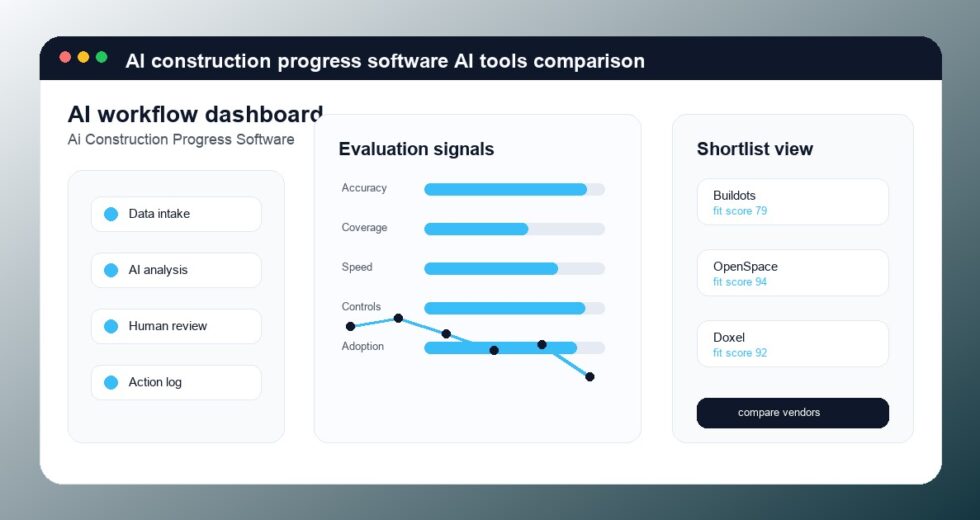
This best overall shortlist compares Buildots, OpenSpace, and Doxel for teams evaluating AI construction progress software. The three tools are not interchangeable. Each may be strong for a different operating model, integration requirement, data maturity level, or rollout style.
For construction owners, general contractors, and field teams, the right decision should start with the workflow: site capture, progress tracking, and project visibility. A tool that looks impressive in a demo may be the wrong fit if it cannot connect to existing systems, handle edge cases, or provide the audit trail your team needs.
Short answer
- Choose Buildots if its workflow depth matches your highest-priority AI construction progress software use case.
- Choose OpenSpace if its implementation model, integrations, or data approach fits construction owners, general contractors, and field teams better.
- Choose Doxel if it offers the strongest match for site capture, progress tracking, and project visibility, rollout needs, or reporting expectations.
- Run a AI construction progress software pilot before making a long-term buying decision.
Comparison table
| Tool | Likely best fit | What to validate | Risk to check |
|---|---|---|---|
| Buildots | Teams prioritizing site capture, progress tracking, and project visibility | Integration depth and real-case performance | Over-reliance on polished demo examples |
| OpenSpace | construction owners, general contractors, and field teams with specific process constraints | Security, data controls, and workflow ownership | Implementation complexity |
| Doxel | Teams comparing multiple approaches to AI construction progress software | Reporting, user adoption, and support model | Unclear ROI measurement |
Buildots: where it may fit best
Buildots belongs on the shortlist when your team wants AI support for site capture, progress tracking, and project visibility and prefers a focused product over a generic AI assistant. The best reason to evaluate Buildots is not simply that it uses AI, but that it may align with the roles, systems, and repeatable decisions inside AI construction progress software.
- Pilot fit: use Buildots on a real site capture, progress tracking, and project visibility process with normal and edge-case examples.
- Data fit: confirm what AI construction progress software sources Buildots needs and how they are governed.
- User fit: test whether construction owners, general contractors, and field teams can understand, edit, and trust Buildots output.
- Commercial fit: ask how Buildots pricing changes as site capture, progress tracking, and project visibility usage expands.
Visit Buildots official website
OpenSpace: where it may fit best
OpenSpace belongs on the shortlist when your team wants AI support for site capture, progress tracking, and project visibility and prefers a focused product over a generic AI assistant. The best reason to evaluate OpenSpace is not simply that it uses AI, but that it may align with the roles, systems, and repeatable decisions inside AI construction progress software.
- Pilot fit: use OpenSpace on a real site capture, progress tracking, and project visibility process with normal and edge-case examples.
- Data fit: confirm what AI construction progress software sources OpenSpace needs and how they are governed.
- User fit: test whether construction owners, general contractors, and field teams can understand, edit, and trust OpenSpace output.
- Commercial fit: ask how OpenSpace pricing changes as site capture, progress tracking, and project visibility usage expands.
Visit OpenSpace official website
Doxel: where it may fit best
Doxel belongs on the shortlist when your team wants AI support for site capture, progress tracking, and project visibility and prefers a focused product over a generic AI assistant. The best reason to evaluate Doxel is not simply that it uses AI, but that it may align with the roles, systems, and repeatable decisions inside AI construction progress software.
- Pilot fit: use Doxel on a real site capture, progress tracking, and project visibility process with normal and edge-case examples.
- Data fit: confirm what AI construction progress software sources Doxel needs and how they are governed.
- User fit: test whether construction owners, general contractors, and field teams can understand, edit, and trust Doxel output.
- Commercial fit: ask how Doxel pricing changes as site capture, progress tracking, and project visibility usage expands.
How to choose between the three
The best buying process is to define a narrow workflow, ask each vendor to run the same examples, and compare output quality, implementation time, governance controls, and reporting. For AI construction progress software, teams should resist buying the broadest feature list and instead choose the platform that improves the most expensive or repetitive bottleneck.
- Give every vendor the same AI construction progress software test cases.
- Score outputs with the construction owners, general contractors, and field teams who will actually use the system.
- Ask for AI construction progress software security and compliance documentation early.
- Measure before-and-after site capture, progress tracking, and project visibility time savings, quality, and exception rates.
- Document which AI construction progress software decisions remain human-owned.
- Confirm cancellation, expansion, and support terms before signing for Buildots, OpenSpace, or Doxel.
Pricing and ROI questions
Pricing in AI construction progress software can vary by seat, usage volume, module, workflow, implementation services, or enterprise security requirements. The practical ROI question is whether the chosen tool reduces measurable bottlenecks in site capture, progress tracking, and project visibility without creating new review or integration costs.
Buyer context
A fair comparison of Buildots, OpenSpace, and Doxel starts with the operating problem. For construction owners, general contractors, and field teams, the target workflow is site capture, progress tracking, and project visibility. The winner should be the product that improves that workflow with the least friction, the clearest review process, and the strongest evidence that users will actually adopt it.
These platforms should not be judged only by interface polish or broad AI claims. In AI construction progress software, buyers need to test real inputs, edge cases, reporting needs, permission boundaries, and what happens after a recommendation, draft, prediction, or summary is produced.
Evaluation rubric
| Criterion | Buildots | OpenSpace | Doxel |
|---|---|---|---|
| Workflow fit | Test against the highest-volume process. | Check whether the implementation model suits the team. | Validate fit for edge cases and expansion. |
| Data handling | Review source traceability and retention. | Check permissions and data controls. | Confirm imports, exports, and audit logs. |
| Adoption | Ask real users to score output usefulness. | Measure training effort and daily friction. | Track edits, overrides, and support needs. |
| ROI | Measure before-and-after cycle time. | Estimate implementation and admin cost. | Check whether reporting proves value. |
Data, controls, and risk
The data layer matters because AI construction progress software may involve workflow data, user activity, documents, messages, product records, and operational context. A strong platform should make it clear how data enters the system, how outputs are created, how permissions work, and how humans can inspect or override results. The most important risk areas are poor source data, weak adoption, unclear ownership, and outputs that are hard to audit.
During a pilot, give all three vendors the same examples and ask them to show source references, confidence boundaries, and exception handling. The goal is not to find the flashiest answer. The goal is to find the most reliable operating process for site capture, progress tracking, and project visibility.
Implementation differences
Do not compare Buildots, OpenSpace, and Doxel only by demo output. Compare the work required to connect systems, configure roles, train users, monitor quality, and keep site capture, progress tracking, and project visibility running after launch.
- Ask whether integrations for site capture, progress tracking, and project visibility are native, partner-built, API-based, or services-led.
- Confirm which construction owners, general contractors, and field teams roles need training before the first production workflow.
- Decide who owns configuration after the AI construction progress software implementation team leaves.
- Check whether AI construction progress software reporting can prove time saved, quality improvement, user adoption, exception handling, and measurable workflow throughput to leadership after launch.
- Document what happens when AI construction progress software AI output is wrong, incomplete, or disputed.
Best-fit scenarios
Buildots may be the best fit when its strengths line up with the most expensive bottleneck in site capture, progress tracking, and project visibility. OpenSpace may be better when implementation style, data controls, or user experience match the buyer's operating model. Doxel may be the stronger option when the team values a different balance of automation, oversight, reporting, and rollout support.
The cleanest way to decide is to run a structured test for site capture, progress tracking, and project visibility. Give Buildots, OpenSpace, and Doxel the same input set, the same success criteria, and the same review team, then compare how each platform handles corrections, handoffs, and reporting.
Pricing and commercial checks
Pricing in AI construction progress software can depend on seats, usage, volume, modules, implementation services, support tier, data connectors, or enterprise security requirements. A low starting price may not stay low after the first workflow expands. A higher quote may still be reasonable if it reduces manual work, improves quality, and fits governance requirements.
- Ask for AI construction progress software pilot pricing and production pricing separately.
- Request a clear definition of usage limits and overage costs for site capture, progress tracking, and project visibility.
- Confirm whether integrations, onboarding, and support are included for Buildots, OpenSpace, or Doxel.
- Ask how the contract changes if more construction owners, general contractors, and field teams teams or workflows are added.
- Tie renewal decisions to measurable AI construction progress software outcomes from the pilot.
Recommendation
For most buyers, the safest recommendation is to choose the platform that improves site capture, progress tracking, and project visibility in a measurable way and gives the team confidence in review, auditability, and exception handling. The best choice may not be the most automated option. It is the option that produces useful output, fits the operating model, and can be governed by the business process owner, an implementation lead, and a reviewer responsible for quality control.
A no-buy decision can be the right outcome if the test shows weak workflow fit. Before revisiting Buildots, OpenSpace, or Doxel, document the current process, clean up source data, and define who owns review.
Proof to request before purchase
Before choosing between Buildots, OpenSpace, and Doxel, ask for proof that goes beyond sales claims. Each vendor should show a workflow walkthrough, a security or data handling summary, a realistic implementation plan, and examples of how customers measure results. In AI construction progress software, a strong proof package should connect product capabilities to site capture, progress tracking, and project visibility, not just describe generic automation.
- A sample AI construction progress software implementation plan with customer responsibilities clearly separated from vendor responsibilities.
- A security and privacy summary for site capture, progress tracking, and project visibility data processing, retention, access control, and logging.
- A reporting example that shows how construction owners, general contractors, and field teams can monitor time saved, quality improvement, user adoption, exception handling, and measurable workflow throughput after site capture, progress tracking, and project visibility goes live.
- A support model for construction owners, general contractors, and field teams that explains what happens after launch, not only during onboarding.
- A pricing model that makes AI construction progress software expansion costs visible before the team commits.
What happens after the AI output
Output quality matters, but the next step matters just as much. For site capture, progress tracking, and project visibility, buyers should ask whether the AI result moves cleanly into review, approval, reporting, or the system of record.
If a vendor cannot show AI construction progress software review history, source context, ownership, and handoff steps, the product may be hard to govern even if its first answer looks impressive.
Shortlist strategy
A useful shortlist strategy narrows the decision in stages. First prove the tool can improve site capture, progress tracking, and project visibility, then prove it can be governed, then prove the economics work at production scale.
| Gate | Pass condition | Decision |
|---|---|---|
| Workflow fit | Improves site capture, progress tracking, and project visibility with real examples. | Advance to user testing. |
| Governance fit | Controls the main risk areas: poor source data, weak adoption, unclear ownership, and outputs that are hard to audit. | Advance to security and compliance review. |
| Economic fit | Improves time saved, quality improvement, user adoption, exception handling, and measurable workflow throughput enough to justify cost. | Advance to contract negotiation. |
FAQ
Which is the best AI construction progress software tool?
There is no universal winner. Buildots, OpenSpace, and Doxel should be compared against your own data, workflows, integrations, and governance requirements.
Should buyers choose the most automated platform?
Automation depth is useful only when the review model is clear. construction owners, general contractors, and field teams should choose the tool that improves site capture, progress tracking, and project visibility without hiding errors, exceptions, or approval steps.
How long should a pilot run?
Run the pilot long enough to see site capture, progress tracking, and project visibility under normal pressure, not only in a curated demo. The team should review easy cases, difficult cases, incomplete inputs, and manager reporting before choosing a vendor.
Related AI software guides
Use these related guides to compare the same category from another buyer angle.
- Doxel Review 2026: AI Construction Progress Software
- OpenSpace Review 2026: AI Construction Progress Software
- Buildots Review 2026: AI Construction Progress Software
This article is a software evaluation guide, not a vendor endorsement. Buyers should verify current AI construction progress software features, pricing, integrations, compliance claims, and support terms directly with the vendor.