
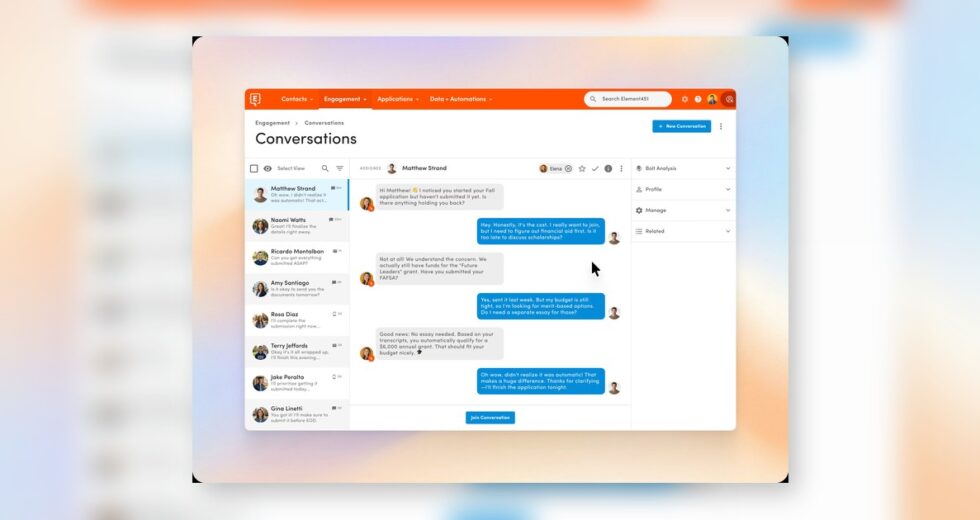
Element451 is one of the AI tools buyers often evaluate when they are looking for AI higher education advising software. This review looks at the product from a practical buyer perspective: what it appears best suited for, which workflows it may improve, what questions to ask before a pilot, and how it compares with other tools in the same category.
The goal is not to crown a universal winner. A strong AI software decision depends on data quality, team workflow, compliance constraints, integration requirements, and the level of human review required in student engagement, advising, and enrollment communication. For colleges, enrollment teams, and student success offices, the best choice is usually the platform that fits the existing operating model with the least friction.
Quick verdict: who Element451 is best for
Element451 is worth shortlisting if your team needs help with student engagement, advising, and enrollment communication. It is especially relevant for colleges, enrollment teams, and student success offices that want a focused AI system rather than a generic chatbot. The most important question is whether the platform supports the exact tasks your team repeats every week.
- Best fit: teams that already have a defined student engagement, advising, and enrollment communication process and want to reduce manual work.
- Potential value: Element451 may speed up student engagement, advising, and enrollment communication through better routing, drafting, analysis, or follow-through.
- Watch-out: Element451 still needs human ownership, documented review steps, and clear escalation rules.
- Buying angle: run a Element451 pilot with real AI higher education advising software examples before committing to a long contract.
What Element451 does
In the AI higher education advising software category, buyers typically look for tools that can collect context, analyze information, generate recommendations or drafts, and push work back into the systems a team already uses. Element451 should be judged by how well it supports that complete loop rather than by a demo alone.
For colleges, enrollment teams, and student success offices, the highest-value use cases usually sit where information is repetitive but still requires judgment. Good AI software should make the routine parts faster while leaving sensitive, strategic, or regulated decisions to the responsible team.
Core use cases to evaluate
- Automating repeatable steps in student engagement, advising, and enrollment communication.
- Summarizing complex AI higher education advising software information into a format a busy team can act on.
- Improving student engagement, advising, and enrollment communication handoffs between departments, systems, or specialists.
- Reducing time spent on low-value manual review while preserving Element451 auditability.
- Creating a more consistent AI higher education advising software process for new team members and distributed teams.
Strengths
The main reason to consider Element451 is category focus. Vertical AI tools can often provide better workflow defaults than general-purpose AI systems because they are designed around the language, data, and user roles of a specific industry.
- More relevant workflow assumptions for AI higher education advising software.
- A clearer buyer conversation around Element451 implementation and measurable outcomes.
- Potential integrations with the systems already used by colleges, enrollment teams, and student success offices.
- Better fit for teams that need repeatable student engagement, advising, and enrollment communication processes rather than one-off prompting.
- A narrower AI higher education advising software scope that can make governance and training easier.
Limitations and risks
Even a strong AI tool can disappoint when teams skip data preparation, workflow mapping, and change management. Element451 should be evaluated with messy real-world examples, not only polished demo data.
- Element451 pricing may depend on volume, seats, enterprise features, or implementation scope.
- Element451 integrations can be the difference between a useful system and an isolated demo.
- AI output for AI higher education advising software can be incomplete, overconfident, or poorly matched to local policy.
- Teams need documented ownership for Element451 review, approval, and exception handling.
- Vendor claims should be tested against your own student engagement, advising, and enrollment communication data and workflows.
Pricing questions
Public pricing may not be enough to estimate total cost for Element451. Buyers should ask about implementation, usage limits, onboarding, support, security review, and the cost of adding more users or workflows later.
- Is Element451 pricing based on users, usage volume, locations, documents, conversations, or transactions?
- Are Element451 integrations, implementation, premium support, or sandbox environments included?
- What happens if Element451 usage grows quickly after the student engagement, advising, and enrollment communication pilot?
- Can the team start with one AI higher education advising software workflow before expanding?
Implementation checklist
- Pick one measurable student engagement, advising, and enrollment communication use case for the first pilot.
- Prepare representative AI higher education advising software examples, including ordinary cases and edge cases.
- Define what Element451 can do automatically and what requires human review.
- Confirm Element451 security, privacy, data retention, and permission controls.
- Agree on student engagement, advising, and enrollment communication success metrics before the pilot starts.
- Review Element451 performance after two weeks and after the first full operating cycle.
Element451 alternatives
Teams comparing Element451 should also look at Mainstay, Stellic. These tools serve the same broad AI higher education advising software category, but they may differ in workflow depth, integrations, buyer focus, and implementation style.
| Tool | Best-fit angle | Evaluation note |
|---|---|---|
| Element451 | student engagement, advising, and enrollment communication | Start with your highest-volume workflow. |
| Mainstay | AI higher education advising software | Compare integration and governance depth. |
| Stellic | AI higher education advising software | Compare reporting, support, and rollout complexity. |
Workflow fit and buying context
A useful Element451 evaluation should begin with the workflow rather than the feature list. In AI higher education advising software, the question is whether the product can improve student engagement, advising, and enrollment communication for colleges, enrollment teams, and student success offices without adding hidden review work. The strongest buyer case is usually a narrow process where inputs are known, exceptions are visible, and the team can measure whether AI assistance improves the current baseline.
Teams should document the current process before looking at demos. Capture who starts the work, where the source data comes from, which systems hold the final record, who approves output, and what happens when a case does not fit the normal pattern. That map makes it easier to judge whether Element451 is solving a real operational problem or simply presenting a polished interface.
Data requirements
Element451 should be tested against the real data conditions of AI higher education advising software: people, learner, candidate, performance, and communication data that must be handled carefully. A vendor demo may look smooth because the examples are complete, clean, and already aligned with the product's assumptions. A serious pilot should include ordinary records, incomplete records, older examples, edge cases, and examples that require a human to reject or rewrite an AI suggestion.
- Confirm which source systems Element451 can read from and write back to.
- Ask how Element451 inherits, logs, and reviews permissions for student engagement, advising, and enrollment communication.
- Check whether Element451 can explain where an output came from.
- Test how Element451 behaves when AI higher education advising software data is missing, conflicting, or outdated.
- Decide which AI higher education advising software data should never be sent to the vendor or model layer.
Integration and operating model
The value of Element451 depends heavily on integration depth. If the product lives outside the systems where people already work, adoption may fade after the first demo. For colleges, enrollment teams, and student success offices, the practical test is whether Element451 reduces handoffs, duplicate entry, manual summarization, or queue review inside student engagement, advising, and enrollment communication.
Before signing a contract for Element451, ask the vendor to walk through the operating model for student engagement, advising, and enrollment communication: timeline, admin roles, data import, training, permission design, exception handling, reporting, and support. The best-fit product for AI higher education advising software is not always the one with the longest checklist; it is the one that creates the least operational drag.
Pilot design
A strong pilot for Element451 should be scoped tightly enough to finish, but realistic enough to reveal problems. Pick one process inside student engagement, advising, and enrollment communication, choose a sample set that includes easy and difficult cases, and compare results against the current manual process. The pilot should measure completion rate, time-to-action, user satisfaction, fairness review, and human override rate.
| Pilot area | What to test | Why it matters |
|---|---|---|
| Input quality | Complete, incomplete, and unusual examples | Shows whether the system handles real operating conditions. |
| Output review | Human edits, approvals, and rejections | Reveals whether the AI helps experts or creates rework. |
| Workflow speed | Time before and after AI assistance | Connects the product to measurable ROI. |
| Governance | Permissions, audit logs, and escalation paths | Controls the main risks in AI higher education advising software: fairness, privacy, accessibility, explainability, and human decision control. |
Governance and review
Element451 should have a clear review model. Teams need to know who owns the final decision, who reviews exceptions, how users report bad output, and how managers monitor quality over time. For this category, a sensible ownership model usually includes HR, learning operations, legal, and the managers or educators who use the output.
The review model for Element451 should be visible before rollout. Teams need to see how permissions, audit logs, edits, approvals, rejected outputs, and exception cases are handled in daily work.
How it compares with alternatives
Element451 should be compared with Mainstay, Stellic using the same examples and the same scoring rubric. One tool may be better for workflow depth, another for implementation speed, and another for reporting or governance. A fair comparison keeps the test cases identical and asks each vendor to show the full workflow after an AI output is produced.
- Compare Element451 with peers on output quality for student engagement, advising, and enrollment communication, not only demo polish.
- Ask each vendor to show how colleges, enrollment teams, and student success offices correct mistakes and improve future results.
- Evaluate whether Element451 reporting helps managers track completion rate, time-to-action, user satisfaction, fairness review, and human override rate for student engagement, advising, and enrollment communication, not just individual activity.
- Check whether Element451 supports expansion after the first successful AI higher education advising software use case.
Decision framework
Shortlist Element451 if it clearly improves student engagement, advising, and enrollment communication, integrates with the systems your team already relies on, and gives reviewers enough control to trust the output. Wait or choose another product if the vendor cannot explain data handling, cannot support your highest-volume use case, or depends on manual work that cancels out the time savings.
The final buying decision should be based on evidence from your pilot. If Element451 reduces measurable friction for colleges, enrollment teams, and student success offices, produces traceable outputs, and gives the right people control over exceptions, it may deserve a deeper rollout. If the value appears only in a narrow demo, keep it on the watchlist and revisit later.
30/60/90 day rollout plan
In the first 30 days, keep the Element451 rollout narrow. Select one team, one workflow, and one set of measurable outcomes. The goal is to prove whether AI assistance can improve student engagement, advising, and enrollment communication without confusing users or weakening review discipline. During this phase, teams should collect baseline metrics, define approval rules, and document the cases where the tool should not be trusted automatically.
By day 60, the team should know whether Element451 is creating real operating leverage. Review time savings, output quality, user adoption, and exception patterns. If users are copying AI output without checking it, the governance model needs work. If users are ignoring the output, the workflow fit may be weak. If reviewers are editing the same mistakes repeatedly, ask the vendor how the system can be configured or improved.
By day 90, decide whether to expand Element451, pause the rollout, or compare alternatives. Expansion should be based on evidence from student engagement, advising, and enrollment communication: cleaner handoffs, lower manual workload, better reporting, and a named owner for ongoing quality.
When not to buy
Element451 may not be the right choice if the team cannot define the workflow it wants to improve, if source data is too inconsistent to support reliable output, or if no one has time to review AI-assisted work. AI software is most useful when it is attached to a specific operating model. It is much less useful when it is bought as a general productivity idea without a clear owner.
- Do not buy Element451 if the vendor cannot explain how outputs are produced and reviewed.
- Do not buy if the AI higher education advising software pilot uses only vendor-selected examples.
- Do not buy if implementation work offsets the promised savings in student engagement, advising, and enrollment communication.
- Do not buy if the security, privacy, or compliance review for Element451 is incomplete.
- Do not buy if the team cannot name the AI higher education advising software metric that should improve after launch.
Scorecard for final selection
| Score area | What a strong result looks like | What a weak result looks like |
|---|---|---|
| Workflow impact | Element451 reduces friction in student engagement, advising, and enrollment communication. | The tool looks useful but does not change daily work. |
| Output quality | Users can trust, edit, and explain the output. | Users must rewrite most of the result. |
| Governance | Permissions, logs, and review steps are clear. | No one knows who owns mistakes or exceptions. |
| Commercial fit | Pricing scales with a believable ROI case. | Costs rise before value is proven. |
Vendor questions to ask
- Which AI higher education advising software workflows are strongest in Element451 today, and which are still roadmap items?
- What AI higher education advising software data is stored, for how long, and where is it processed?
- Can Element451 admins control permissions by role, team, location, or record type?
- How are Element451 AI outputs logged, reviewed, corrected, and audited?
- What implementation work does Element451 require from the customer side?
- Which Element451 integrations are native, services-led, API-based, or not supported?
- How does Element451 pricing change as volume, users, or workflows increase?
- What support does Element451 provide after the student engagement, advising, and enrollment communication pilot?
FAQ
Is Element451 the best AI tool for AI higher education advising software?
It can be a good option when student engagement, advising, and enrollment communication is the bottleneck your team wants to improve. The safer answer is to compare Element451 with the current manual process and with the closest alternatives before making a long contract decision.
Does Element451 replace a human team?
Element451 should be evaluated as workflow assistance, not a complete replacement plan. The safer question is which parts of student engagement, advising, and enrollment communication can move faster while humans keep accountability for review, judgment, and outcomes.
What should buyers test first?
Test the highest-friction part of student engagement, advising, and enrollment communication. Use real examples, define pass/fail criteria, and compare the AI-assisted process with the current manual process.
Visit Element451 official website
Related AI software guides
Use these related guides to compare the same category from another buyer angle.
This article is a software evaluation guide, not a vendor endorsement. Buyers should verify current AI higher education advising software features, pricing, integrations, compliance claims, and support terms directly with the vendor.