
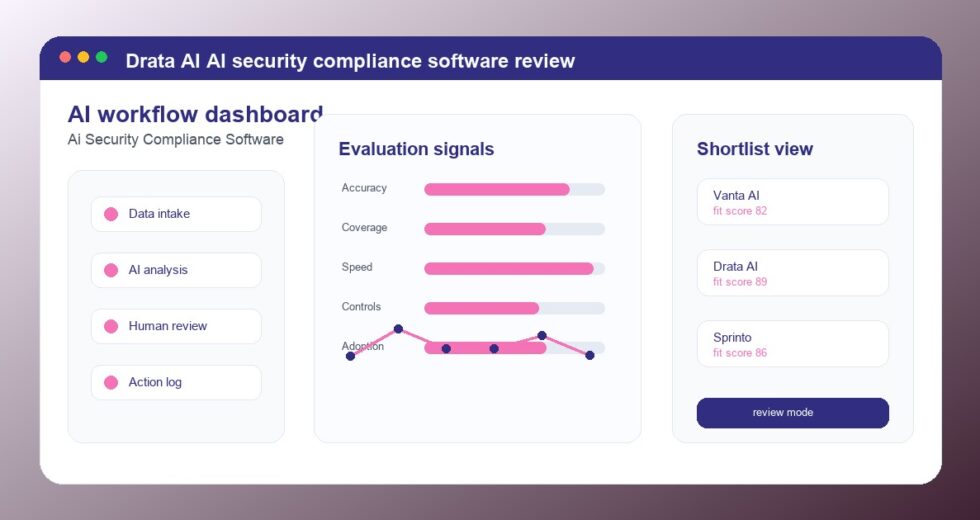
Drata AI is one of the AI tools buyers often evaluate when they are looking for AI security compliance software. This review looks at the product from a practical buyer perspective: what it appears best suited for, which workflows it may improve, what questions to ask before a pilot, and how it compares with other tools in the same category.
The goal is not to crown a universal winner. A strong AI software decision depends on data quality, team workflow, compliance constraints, integration requirements, and the level of human review required in SOC 2, ISO, risk evidence, and compliance automation. For security, compliance, and startup operations teams, the best choice is usually the platform that fits the existing operating model with the least friction.
Quick verdict: who Drata AI is best for
Drata AI is worth shortlisting if your team needs help with SOC 2, ISO, risk evidence, and compliance automation. It is especially relevant for security, compliance, and startup operations teams that want a focused AI system rather than a generic chatbot. The most important question is whether the platform supports the exact tasks your team repeats every week.
- Best fit: teams that already have a defined SOC 2, ISO, risk evidence, and compliance automation process and want to reduce manual work.
- Potential value: Drata AI may speed up SOC 2, ISO, risk evidence, and compliance automation through better routing, drafting, analysis, or follow-through.
- Watch-out: Drata AI still needs human ownership, documented review steps, and clear escalation rules.
- Buying angle: run a Drata AI pilot with real AI security compliance software examples before committing to a long contract.
What Drata AI does
In the AI security compliance software category, buyers typically look for tools that can collect context, analyze information, generate recommendations or drafts, and push work back into the systems a team already uses. Drata AI should be judged by how well it supports that complete loop rather than by a demo alone.
For security, compliance, and startup operations teams, the highest-value use cases usually sit where information is repetitive but still requires judgment. Good AI software should make the routine parts faster while leaving sensitive, strategic, or regulated decisions to the responsible team.
Core use cases to evaluate
- Automating repeatable steps in SOC 2, ISO, risk evidence, and compliance automation.
- Summarizing complex AI security compliance software information into a format a busy team can act on.
- Improving SOC 2, ISO, risk evidence, and compliance automation handoffs between departments, systems, or specialists.
- Reducing time spent on low-value manual review while preserving Drata AI auditability.
- Creating a more consistent AI security compliance software process for new team members and distributed teams.
Strengths
The main reason to consider Drata AI is category focus. Vertical AI tools can often provide better workflow defaults than general-purpose AI systems because they are designed around the language, data, and user roles of a specific industry.
- More relevant workflow assumptions for AI security compliance software.
- A clearer buyer conversation around Drata AI implementation and measurable outcomes.
- Potential integrations with the systems already used by security, compliance, and startup operations teams.
- Better fit for teams that need repeatable SOC 2, ISO, risk evidence, and compliance automation processes rather than one-off prompting.
- A narrower AI security compliance software scope that can make governance and training easier.
Limitations and risks
Even a strong AI tool can disappoint when teams skip data preparation, workflow mapping, and change management. Drata AI should be evaluated with messy real-world examples, not only polished demo data.
- Drata AI pricing may depend on volume, seats, enterprise features, or implementation scope.
- Drata AI integrations can be the difference between a useful system and an isolated demo.
- AI output for AI security compliance software can be incomplete, overconfident, or poorly matched to local policy.
- Teams need documented ownership for Drata AI review, approval, and exception handling.
- Vendor claims should be tested against your own SOC 2, ISO, risk evidence, and compliance automation data and workflows.
Pricing questions
Public pricing may not be enough to estimate total cost for Drata AI. Buyers should ask about implementation, usage limits, onboarding, support, security review, and the cost of adding more users or workflows later.
- Is Drata AI pricing based on users, usage volume, locations, documents, conversations, or transactions?
- Are Drata AI integrations, implementation, premium support, or sandbox environments included?
- What happens if Drata AI usage grows quickly after the SOC 2, ISO, risk evidence, and compliance automation pilot?
- Can the team start with one AI security compliance software workflow before expanding?
Implementation checklist
- Pick one measurable SOC 2, ISO, risk evidence, and compliance automation use case for the first pilot.
- Prepare representative AI security compliance software examples, including ordinary cases and edge cases.
- Define what Drata AI can do automatically and what requires human review.
- Confirm Drata AI security, privacy, data retention, and permission controls.
- Agree on SOC 2, ISO, risk evidence, and compliance automation success metrics before the pilot starts.
- Review Drata AI performance after two weeks and after the first full operating cycle.
Drata AI alternatives
Teams comparing Drata AI should also look at Vanta AI, Sprinto. These tools serve the same broad AI security compliance software category, but they may differ in workflow depth, integrations, buyer focus, and implementation style.
| Tool | Best-fit angle | Evaluation note |
|---|---|---|
| Drata AI | SOC 2, ISO, risk evidence, and compliance automation | Start with your highest-volume workflow. |
| Vanta AI | AI security compliance software | Compare integration and governance depth. |
| Sprinto | AI security compliance software | Compare reporting, support, and rollout complexity. |
Workflow fit and buying context
A useful Drata AI evaluation should begin with the workflow rather than the feature list. In AI security compliance software, the question is whether the product can improve SOC 2, ISO, risk evidence, and compliance automation for security, compliance, and startup operations teams without adding hidden review work. The strongest buyer case is usually a narrow process where inputs are known, exceptions are visible, and the team can measure whether AI assistance improves the current baseline.
Teams should document the current process before looking at demos. Capture who starts the work, where the source data comes from, which systems hold the final record, who approves output, and what happens when a case does not fit the normal pattern. That map makes it easier to judge whether Drata AI is solving a real operational problem or simply presenting a polished interface.
Data requirements
Drata AI should be tested against the real data conditions of AI security compliance software: alerts, evidence, logs, controls, cloud assets, policies, and investigation notes. A vendor demo may look smooth because the examples are complete, clean, and already aligned with the product's assumptions. A serious pilot should include ordinary records, incomplete records, older examples, edge cases, and examples that require a human to reject or rewrite an AI suggestion.
- Confirm which source systems Drata AI can read from and write back to.
- Ask how Drata AI inherits, logs, and reviews permissions for SOC 2, ISO, risk evidence, and compliance automation.
- Check whether Drata AI can explain where an output came from.
- Test how Drata AI behaves when AI security compliance software data is missing, conflicting, or outdated.
- Decide which AI security compliance software data should never be sent to the vendor or model layer.
Integration and operating model
The value of Drata AI depends heavily on integration depth. If the product lives outside the systems where people already work, adoption may fade after the first demo. For security, compliance, and startup operations teams, the practical test is whether Drata AI reduces handoffs, duplicate entry, manual summarization, or queue review inside SOC 2, ISO, risk evidence, and compliance automation.
A useful Drata AI buying conversation should include the unglamorous details: onboarding effort, data cleanup, reviewer responsibilities, admin ownership, support response times, and the work required to keep the system reliable after the first pilot.
Pilot design
A strong pilot for Drata AI should be scoped tightly enough to finish, but realistic enough to reveal problems. Pick one process inside SOC 2, ISO, risk evidence, and compliance automation, choose a sample set that includes easy and difficult cases, and compare results against the current manual process. The pilot should measure mean time to triage, alert quality, evidence completeness, and reduced manual investigation work.
| Pilot area | What to test | Why it matters |
|---|---|---|
| Input quality | Complete, incomplete, and unusual examples | Shows whether the system handles real operating conditions. |
| Output review | Human edits, approvals, and rejections | Reveals whether the AI helps experts or creates rework. |
| Workflow speed | Time before and after AI assistance | Connects the product to measurable ROI. |
| Governance | Permissions, audit logs, and escalation paths | Controls the main risks in AI security compliance software: false positives, incomplete evidence, permission boundaries, and operational accountability. |
Governance and review
Drata AI should have a clear review model. Teams need to know who owns the final decision, who reviews exceptions, how users report bad output, and how managers monitor quality over time. For this category, a sensible ownership model usually includes security operations, compliance, IT, and the process owner accountable for remediation.
For AI security compliance software, governance is a product-fit issue. A strong Drata AI pilot should prove that reviewers can understand where outputs came from, correct them, and explain decisions later without rebuilding the whole workflow manually.
How it compares with alternatives
Drata AI should be compared with Vanta AI, Sprinto using the same examples and the same scoring rubric. One tool may be better for workflow depth, another for implementation speed, and another for reporting or governance. A fair comparison keeps the test cases identical and asks each vendor to show the full workflow after an AI output is produced.
- Compare Drata AI with peers on output quality for SOC 2, ISO, risk evidence, and compliance automation, not only demo polish.
- Ask each vendor to show how security, compliance, and startup operations teams correct mistakes and improve future results.
- Evaluate whether Drata AI reporting helps managers track mean time to triage, alert quality, evidence completeness, and reduced manual investigation work for SOC 2, ISO, risk evidence, and compliance automation, not just individual activity.
- Check whether Drata AI supports expansion after the first successful AI security compliance software use case.
Decision framework
Shortlist Drata AI if it clearly improves SOC 2, ISO, risk evidence, and compliance automation, integrates with the systems your team already relies on, and gives reviewers enough control to trust the output. Wait or choose another product if the vendor cannot explain data handling, cannot support your highest-volume use case, or depends on manual work that cancels out the time savings.
The final buying decision should be based on evidence from your pilot. If Drata AI reduces measurable friction for security, compliance, and startup operations teams, produces traceable outputs, and gives the right people control over exceptions, it may deserve a deeper rollout. If the value appears only in a narrow demo, keep it on the watchlist and revisit later.
30/60/90 day rollout plan
In the first 30 days, keep the Drata AI rollout narrow. Select one team, one workflow, and one set of measurable outcomes. The goal is to prove whether AI assistance can improve SOC 2, ISO, risk evidence, and compliance automation without confusing users or weakening review discipline. During this phase, teams should collect baseline metrics, define approval rules, and document the cases where the tool should not be trusted automatically.
By day 60, the team should know whether Drata AI is creating real operating leverage. Review time savings, output quality, user adoption, and exception patterns. If users are copying AI output without checking it, the governance model needs work. If users are ignoring the output, the workflow fit may be weak. If reviewers are editing the same mistakes repeatedly, ask the vendor how the system can be configured or improved.
The 90-day decision should separate useful automation from novelty. Continue with Drata AI only if users can show how the tool improves real cases, handles exceptions, and supports a repeatable review model.
When not to buy
Drata AI may not be the right choice if the team cannot define the workflow it wants to improve, if source data is too inconsistent to support reliable output, or if no one has time to review AI-assisted work. AI software is most useful when it is attached to a specific operating model. It is much less useful when it is bought as a general productivity idea without a clear owner.
- Do not buy Drata AI if the vendor cannot explain how outputs are produced and reviewed.
- Do not buy if the AI security compliance software pilot uses only vendor-selected examples.
- Do not buy if implementation work offsets the promised savings in SOC 2, ISO, risk evidence, and compliance automation.
- Do not buy if the security, privacy, or compliance review for Drata AI is incomplete.
- Do not buy if the team cannot name the AI security compliance software metric that should improve after launch.
Scorecard for final selection
| Score area | What a strong result looks like | What a weak result looks like |
|---|---|---|
| Workflow impact | Drata AI reduces friction in SOC 2, ISO, risk evidence, and compliance automation. | The tool looks useful but does not change daily work. |
| Output quality | Users can trust, edit, and explain the output. | Users must rewrite most of the result. |
| Governance | Permissions, logs, and review steps are clear. | No one knows who owns mistakes or exceptions. |
| Commercial fit | Pricing scales with a believable ROI case. | Costs rise before value is proven. |
Vendor questions to ask
- Which AI security compliance software workflows are strongest in Drata AI today, and which are still roadmap items?
- What AI security compliance software data is stored, for how long, and where is it processed?
- Can Drata AI admins control permissions by role, team, location, or record type?
- How are Drata AI AI outputs logged, reviewed, corrected, and audited?
- What implementation work does Drata AI require from the customer side?
- Which Drata AI integrations are native, services-led, API-based, or not supported?
- How does Drata AI pricing change as volume, users, or workflows increase?
- What support does Drata AI provide after the SOC 2, ISO, risk evidence, and compliance automation pilot?
FAQ
Is Drata AI the best AI tool for AI security compliance software?
Drata AI may be a strong candidate for AI security compliance software, but it should win the shortlist through evidence from your workflow, data, integrations, and review process. Treat this review as a buying guide, then validate the fit with a pilot.
Does Drata AI replace a human team?
The practical goal is leverage, not blind automation. Drata AI is more likely to succeed when the team uses it to reduce repetitive work while preserving review authority and escalation paths.
What should buyers test first?
Test the highest-friction part of SOC 2, ISO, risk evidence, and compliance automation. Use real examples, define pass/fail criteria, and compare the AI-assisted process with the current manual process.
Visit Drata AI official website
Related AI software guides
Use these related guides to compare the same category from another buyer angle.
This review is for AI security compliance software research and buying workflow planning. Teams should confirm current capabilities, pricing, security documentation, implementation requirements, and contract terms with the vendor.