
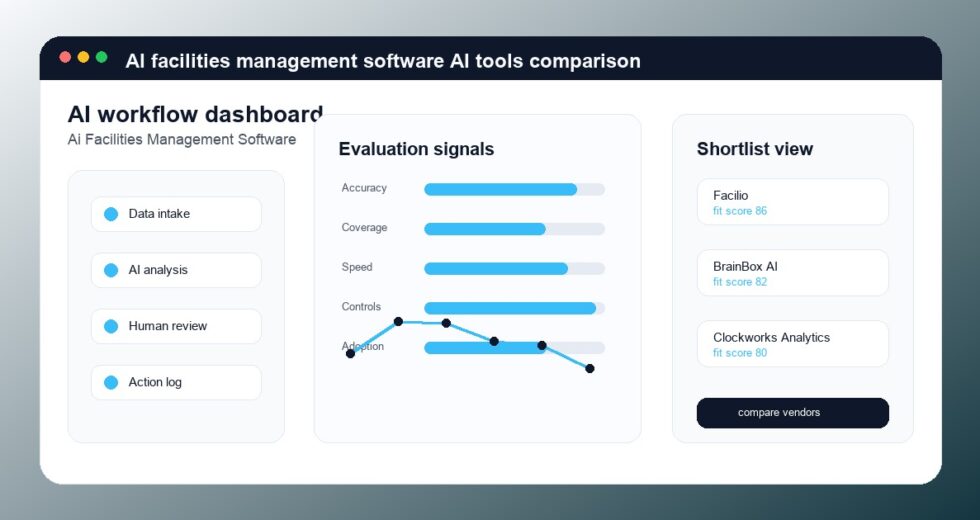
This best overall shortlist compares Facilio, BrainBox AI, and Clockworks Analytics for teams evaluating AI facilities management software. The three tools are not interchangeable. Each may be strong for a different operating model, integration requirement, data maturity level, or rollout style.
For building owners, facilities teams, and property operations, the right decision should start with the workflow: building optimization, equipment analytics, and maintenance intelligence. A tool that looks impressive in a demo may be the wrong fit if it cannot connect to existing systems, handle edge cases, or provide the audit trail your team needs.
Short answer
- Choose Facilio if its workflow depth matches your highest-priority AI facilities management software use case.
- Choose BrainBox AI if its implementation model, integrations, or data approach fits building owners, facilities teams, and property operations better.
- Choose Clockworks Analytics if it offers the strongest match for building optimization, equipment analytics, and maintenance intelligence, rollout needs, or reporting expectations.
- Run a AI facilities management software pilot before making a long-term buying decision.
Comparison table
| Tool | Likely best fit | What to validate | Risk to check |
|---|---|---|---|
| Facilio | Teams prioritizing building optimization, equipment analytics, and maintenance intelligence | Integration depth and real-case performance | Over-reliance on polished demo examples |
| BrainBox AI | building owners, facilities teams, and property operations with specific process constraints | Security, data controls, and workflow ownership | Implementation complexity |
| Clockworks Analytics | Teams comparing multiple approaches to AI facilities management software | Reporting, user adoption, and support model | Unclear ROI measurement |
Facilio: where it may fit best
Facilio belongs on the shortlist when your team wants AI support for building optimization, equipment analytics, and maintenance intelligence and prefers a focused product over a generic AI assistant. The best reason to evaluate Facilio is not simply that it uses AI, but that it may align with the roles, systems, and repeatable decisions inside AI facilities management software.
- Pilot fit: use Facilio on a real building optimization, equipment analytics, and maintenance intelligence process with normal and edge-case examples.
- Data fit: confirm what AI facilities management software sources Facilio needs and how they are governed.
- User fit: test whether building owners, facilities teams, and property operations can understand, edit, and trust Facilio output.
- Commercial fit: ask how Facilio pricing changes as building optimization, equipment analytics, and maintenance intelligence usage expands.
Visit Facilio official website
BrainBox AI: where it may fit best
BrainBox AI belongs on the shortlist when your team wants AI support for building optimization, equipment analytics, and maintenance intelligence and prefers a focused product over a generic AI assistant. The best reason to evaluate BrainBox AI is not simply that it uses AI, but that it may align with the roles, systems, and repeatable decisions inside AI facilities management software.
- Pilot fit: use BrainBox AI on a real building optimization, equipment analytics, and maintenance intelligence process with normal and edge-case examples.
- Data fit: confirm what AI facilities management software sources BrainBox AI needs and how they are governed.
- User fit: test whether building owners, facilities teams, and property operations can understand, edit, and trust BrainBox AI output.
- Commercial fit: ask how BrainBox AI pricing changes as building optimization, equipment analytics, and maintenance intelligence usage expands.
Visit BrainBox AI official website
Clockworks Analytics: where it may fit best
Clockworks Analytics belongs on the shortlist when your team wants AI support for building optimization, equipment analytics, and maintenance intelligence and prefers a focused product over a generic AI assistant. The best reason to evaluate Clockworks Analytics is not simply that it uses AI, but that it may align with the roles, systems, and repeatable decisions inside AI facilities management software.
- Pilot fit: use Clockworks Analytics on a real building optimization, equipment analytics, and maintenance intelligence process with normal and edge-case examples.
- Data fit: confirm what AI facilities management software sources Clockworks Analytics needs and how they are governed.
- User fit: test whether building owners, facilities teams, and property operations can understand, edit, and trust Clockworks Analytics output.
- Commercial fit: ask how Clockworks Analytics pricing changes as building optimization, equipment analytics, and maintenance intelligence usage expands.
Visit Clockworks Analytics official website
How to choose between the three
The best buying process is to define a narrow workflow, ask each vendor to run the same examples, and compare output quality, implementation time, governance controls, and reporting. For AI facilities management software, teams should resist buying the broadest feature list and instead choose the platform that improves the most expensive or repetitive bottleneck.
- Give every vendor the same AI facilities management software test cases.
- Score outputs with the building owners, facilities teams, and property operations who will actually use the system.
- Ask for AI facilities management software security and compliance documentation early.
- Measure before-and-after building optimization, equipment analytics, and maintenance intelligence time savings, quality, and exception rates.
- Document which AI facilities management software decisions remain human-owned.
- Confirm cancellation, expansion, and support terms before signing for Facilio, BrainBox AI, or Clockworks Analytics.
Pricing and ROI questions
Pricing in AI facilities management software can vary by seat, usage volume, module, workflow, implementation services, or enterprise security requirements. The practical ROI question is whether the chosen tool reduces measurable bottlenecks in building optimization, equipment analytics, and maintenance intelligence without creating new review or integration costs.
Buyer context
A fair comparison of Facilio, BrainBox AI, and Clockworks Analytics starts with the operating problem. For building owners, facilities teams, and property operations, the target workflow is building optimization, equipment analytics, and maintenance intelligence. The winner should be the product that improves that workflow with the least friction, the clearest review process, and the strongest evidence that users will actually adopt it.
These platforms should not be judged only by interface polish or broad AI claims. In AI facilities management software, buyers need to test real inputs, edge cases, reporting needs, permission boundaries, and what happens after a recommendation, draft, prediction, or summary is produced.
Evaluation rubric
| Criterion | Facilio | BrainBox AI | Clockworks Analytics |
|---|---|---|---|
| Workflow fit | Test against the highest-volume process. | Check whether the implementation model suits the team. | Validate fit for edge cases and expansion. |
| Data handling | Review source traceability and retention. | Check permissions and data controls. | Confirm imports, exports, and audit logs. |
| Adoption | Ask real users to score output usefulness. | Measure training effort and daily friction. | Track edits, overrides, and support needs. |
| ROI | Measure before-and-after cycle time. | Estimate implementation and admin cost. | Check whether reporting proves value. |
Data, controls, and risk
The data layer matters because AI facilities management software may involve workflow data, user activity, documents, messages, product records, and operational context. A strong platform should make it clear how data enters the system, how outputs are created, how permissions work, and how humans can inspect or override results. The most important risk areas are poor source data, weak adoption, unclear ownership, and outputs that are hard to audit.
During a pilot, give all three vendors the same examples and ask them to show source references, confidence boundaries, and exception handling. The goal is not to find the flashiest answer. The goal is to find the most reliable operating process for building optimization, equipment analytics, and maintenance intelligence.
Implementation differences
Do not compare Facilio, BrainBox AI, and Clockworks Analytics only by demo output. Compare the work required to connect systems, configure roles, train users, monitor quality, and keep building optimization, equipment analytics, and maintenance intelligence running after launch.
- Ask whether integrations for building optimization, equipment analytics, and maintenance intelligence are native, partner-built, API-based, or services-led.
- Confirm which building owners, facilities teams, and property operations roles need training before the first production workflow.
- Decide who owns configuration after the AI facilities management software implementation team leaves.
- Check whether AI facilities management software reporting can prove time saved, quality improvement, user adoption, exception handling, and measurable workflow throughput to leadership after launch.
- Document what happens when AI facilities management software AI output is wrong, incomplete, or disputed.
Best-fit scenarios
Facilio may be the best fit when its strengths line up with the most expensive bottleneck in building optimization, equipment analytics, and maintenance intelligence. BrainBox AI may be better when implementation style, data controls, or user experience match the buyer's operating model. Clockworks Analytics may be the stronger option when the team values a different balance of automation, oversight, reporting, and rollout support.
The cleanest way to decide is to run a structured test for building optimization, equipment analytics, and maintenance intelligence. Give Facilio, BrainBox AI, and Clockworks Analytics the same input set, the same success criteria, and the same review team, then compare how each platform handles corrections, handoffs, and reporting.
Pricing and commercial checks
Pricing in AI facilities management software can depend on seats, usage, volume, modules, implementation services, support tier, data connectors, or enterprise security requirements. A low starting price may not stay low after the first workflow expands. A higher quote may still be reasonable if it reduces manual work, improves quality, and fits governance requirements.
- Ask for AI facilities management software pilot pricing and production pricing separately.
- Request a clear definition of usage limits and overage costs for building optimization, equipment analytics, and maintenance intelligence.
- Confirm whether integrations, onboarding, and support are included for Facilio, BrainBox AI, or Clockworks Analytics.
- Ask how the contract changes if more building owners, facilities teams, and property operations teams or workflows are added.
- Tie renewal decisions to measurable AI facilities management software outcomes from the pilot.
Recommendation
For most buyers, the safest recommendation is to choose the platform that improves building optimization, equipment analytics, and maintenance intelligence in a measurable way and gives the team confidence in review, auditability, and exception handling. The best choice may not be the most automated option. It is the option that produces useful output, fits the operating model, and can be governed by the business process owner, an implementation lead, and a reviewer responsible for quality control.
A no-buy decision can be the right outcome if the test shows weak workflow fit. Before revisiting Facilio, BrainBox AI, or Clockworks Analytics, document the current process, clean up source data, and define who owns review.
Proof to request before purchase
Before choosing between Facilio, BrainBox AI, and Clockworks Analytics, ask for proof that goes beyond sales claims. Each vendor should show a workflow walkthrough, a security or data handling summary, a realistic implementation plan, and examples of how customers measure results. In AI facilities management software, a strong proof package should connect product capabilities to building optimization, equipment analytics, and maintenance intelligence, not just describe generic automation.
- A sample AI facilities management software implementation plan with customer responsibilities clearly separated from vendor responsibilities.
- A security and privacy summary for building optimization, equipment analytics, and maintenance intelligence data processing, retention, access control, and logging.
- A reporting example that shows how building owners, facilities teams, and property operations can monitor time saved, quality improvement, user adoption, exception handling, and measurable workflow throughput after building optimization, equipment analytics, and maintenance intelligence goes live.
- A support model for building owners, facilities teams, and property operations that explains what happens after launch, not only during onboarding.
- A pricing model that makes AI facilities management software expansion costs visible before the team commits.
What happens after the AI output
Output quality matters, but the next step matters just as much. For building optimization, equipment analytics, and maintenance intelligence, buyers should ask whether the AI result moves cleanly into review, approval, reporting, or the system of record.
If a vendor cannot show AI facilities management software review history, source context, ownership, and handoff steps, the product may be hard to govern even if its first answer looks impressive.
Shortlist strategy
A useful shortlist strategy narrows the decision in stages. First prove the tool can improve building optimization, equipment analytics, and maintenance intelligence, then prove it can be governed, then prove the economics work at production scale.
| Gate | Pass condition | Decision |
|---|---|---|
| Workflow fit | Improves building optimization, equipment analytics, and maintenance intelligence with real examples. | Advance to user testing. |
| Governance fit | Controls the main risk areas: poor source data, weak adoption, unclear ownership, and outputs that are hard to audit. | Advance to security and compliance review. |
| Economic fit | Improves time saved, quality improvement, user adoption, exception handling, and measurable workflow throughput enough to justify cost. | Advance to contract negotiation. |
FAQ
Which is the best AI facilities management software tool?
There is no universal winner. Facilio, BrainBox AI, and Clockworks Analytics should be compared against your own data, workflows, integrations, and governance requirements.
Should buyers choose the most automated platform?
Automation depth is useful only when the review model is clear. building owners, facilities teams, and property operations should choose the tool that improves building optimization, equipment analytics, and maintenance intelligence without hiding errors, exceptions, or approval steps.
How long should a pilot run?
Run the pilot long enough to see building optimization, equipment analytics, and maintenance intelligence under normal pressure, not only in a curated demo. The team should review easy cases, difficult cases, incomplete inputs, and manager reporting before choosing a vendor.
Related AI software guides
Use these related guides to compare the same category from another buyer angle.
- Clockworks Analytics Review 2026: AI Facilities Management
- BrainBox AI Review 2026: AI Facilities Management Software
- Facilio Review 2026: AI Facilities Management Software
This page is intended to help buyers evaluate AI facilities management software options. Current product details, commercial terms, security posture, and compliance documentation should be checked with the vendor before deployment.