
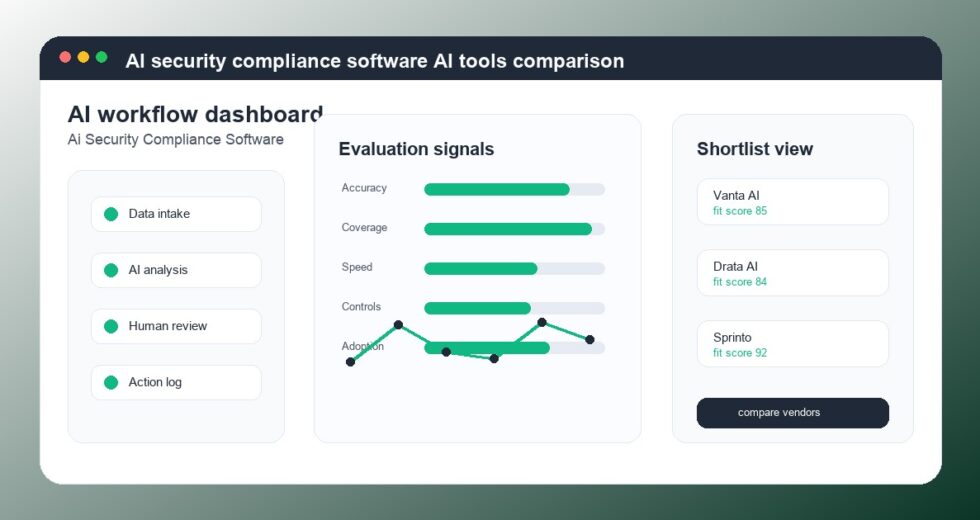
This side-by-side buyer comparison compares Vanta AI, Drata AI, and Sprinto for teams evaluating AI security compliance software. The three tools are not interchangeable. Each may be strong for a different operating model, integration requirement, data maturity level, or rollout style.
For security, compliance, and startup operations teams, the right decision should start with the workflow: SOC 2, ISO, risk evidence, and compliance automation. A tool that looks impressive in a demo may be the wrong fit if it cannot connect to existing systems, handle edge cases, or provide the audit trail your team needs.
Short answer
- Choose Vanta AI if its workflow depth matches your highest-priority AI security compliance software use case.
- Choose Drata AI if its implementation model, integrations, or data approach fits security, compliance, and startup operations teams better.
- Choose Sprinto if it offers the strongest match for SOC 2, ISO, risk evidence, and compliance automation, rollout needs, or reporting expectations.
- Run a AI security compliance software pilot before making a long-term buying decision.
Comparison table
| Tool | Likely best fit | What to validate | Risk to check |
|---|---|---|---|
| Vanta AI | Teams prioritizing SOC 2, ISO, risk evidence, and compliance automation | Integration depth and real-case performance | Over-reliance on polished demo examples |
| Drata AI | security, compliance, and startup operations teams with specific process constraints | Security, data controls, and workflow ownership | Implementation complexity |
| Sprinto | Teams comparing multiple approaches to AI security compliance software | Reporting, user adoption, and support model | Unclear ROI measurement |
Vanta AI: where it may fit best
Vanta AI belongs on the shortlist when your team wants AI support for SOC 2, ISO, risk evidence, and compliance automation and prefers a focused product over a generic AI assistant. The best reason to evaluate Vanta AI is not simply that it uses AI, but that it may align with the roles, systems, and repeatable decisions inside AI security compliance software.
- Pilot fit: use Vanta AI on a real SOC 2, ISO, risk evidence, and compliance automation process with normal and edge-case examples.
- Data fit: confirm what AI security compliance software sources Vanta AI needs and how they are governed.
- User fit: test whether security, compliance, and startup operations teams can understand, edit, and trust Vanta AI output.
- Commercial fit: ask how Vanta AI pricing changes as SOC 2, ISO, risk evidence, and compliance automation usage expands.
Visit Vanta AI official website
Drata AI: where it may fit best
Drata AI belongs on the shortlist when your team wants AI support for SOC 2, ISO, risk evidence, and compliance automation and prefers a focused product over a generic AI assistant. The best reason to evaluate Drata AI is not simply that it uses AI, but that it may align with the roles, systems, and repeatable decisions inside AI security compliance software.
- Pilot fit: use Drata AI on a real SOC 2, ISO, risk evidence, and compliance automation process with normal and edge-case examples.
- Data fit: confirm what AI security compliance software sources Drata AI needs and how they are governed.
- User fit: test whether security, compliance, and startup operations teams can understand, edit, and trust Drata AI output.
- Commercial fit: ask how Drata AI pricing changes as SOC 2, ISO, risk evidence, and compliance automation usage expands.
Visit Drata AI official website
Sprinto: where it may fit best
Sprinto belongs on the shortlist when your team wants AI support for SOC 2, ISO, risk evidence, and compliance automation and prefers a focused product over a generic AI assistant. The best reason to evaluate Sprinto is not simply that it uses AI, but that it may align with the roles, systems, and repeatable decisions inside AI security compliance software.
- Pilot fit: use Sprinto on a real SOC 2, ISO, risk evidence, and compliance automation process with normal and edge-case examples.
- Data fit: confirm what AI security compliance software sources Sprinto needs and how they are governed.
- User fit: test whether security, compliance, and startup operations teams can understand, edit, and trust Sprinto output.
- Commercial fit: ask how Sprinto pricing changes as SOC 2, ISO, risk evidence, and compliance automation usage expands.
Visit Sprinto official website
How to choose between the three
The best buying process is to define a narrow workflow, ask each vendor to run the same examples, and compare output quality, implementation time, governance controls, and reporting. For AI security compliance software, teams should resist buying the broadest feature list and instead choose the platform that improves the most expensive or repetitive bottleneck.
- Give every vendor the same AI security compliance software test cases.
- Score outputs with the security, compliance, and startup operations teams who will actually use the system.
- Ask for AI security compliance software security and compliance documentation early.
- Measure before-and-after SOC 2, ISO, risk evidence, and compliance automation time savings, quality, and exception rates.
- Document which AI security compliance software decisions remain human-owned.
- Confirm cancellation, expansion, and support terms before signing for Vanta AI, Drata AI, or Sprinto.
Pricing and ROI questions
Buyers should compare price against operating impact, not against AI hype. For security, compliance, and startup operations teams, the right model is the one where cost scales in a way the team can connect to time saved, quality gains, lower exception volume, or better reporting.
Buyer context
A fair comparison of Vanta AI, Drata AI, and Sprinto starts with the operating problem. For security, compliance, and startup operations teams, the target workflow is SOC 2, ISO, risk evidence, and compliance automation. The winner should be the product that improves that workflow with the least friction, the clearest review process, and the strongest evidence that users will actually adopt it.
These platforms should not be judged only by interface polish or broad AI claims. In AI security compliance software, buyers need to test real inputs, edge cases, reporting needs, permission boundaries, and what happens after a recommendation, draft, prediction, or summary is produced.
Evaluation rubric
| Criterion | Vanta AI | Drata AI | Sprinto |
|---|---|---|---|
| Workflow fit | Test against the highest-volume process. | Check whether the implementation model suits the team. | Validate fit for edge cases and expansion. |
| Data handling | Review source traceability and retention. | Check permissions and data controls. | Confirm imports, exports, and audit logs. |
| Adoption | Ask real users to score output usefulness. | Measure training effort and daily friction. | Track edits, overrides, and support needs. |
| ROI | Measure before-and-after cycle time. | Estimate implementation and admin cost. | Check whether reporting proves value. |
Data, controls, and risk
The data layer matters because AI security compliance software may involve alerts, evidence, logs, controls, cloud assets, policies, and investigation notes. A strong platform should make it clear how data enters the system, how outputs are created, how permissions work, and how humans can inspect or override results. The most important risk areas are false positives, incomplete evidence, permission boundaries, and operational accountability.
During a pilot, give all three vendors the same examples and ask them to show source references, confidence boundaries, and exception handling. The goal is not to find the flashiest answer. The goal is to find the most reliable operating process for SOC 2, ISO, risk evidence, and compliance automation.
Implementation differences
Vanta AI, Drata AI, and Sprinto may require different levels of configuration, integration, training, and change management. Buyers should ask each vendor for a realistic plan covering timeline, customer responsibilities, admin setup, security review, and the handoff from pilot to production.
- Ask whether integrations for SOC 2, ISO, risk evidence, and compliance automation are native, partner-built, API-based, or services-led.
- Confirm which security, compliance, and startup operations teams roles need training before the first production workflow.
- Decide who owns configuration after the AI security compliance software implementation team leaves.
- Check whether AI security compliance software reporting can prove mean time to triage, alert quality, evidence completeness, and reduced manual investigation work to leadership after launch.
- Document what happens when AI security compliance software AI output is wrong, incomplete, or disputed.
Best-fit scenarios
Vanta AI may be the best fit when its strengths line up with the most expensive bottleneck in SOC 2, ISO, risk evidence, and compliance automation. Drata AI may be better when implementation style, data controls, or user experience match the buyer's operating model. Sprinto may be the stronger option when the team values a different balance of automation, oversight, reporting, and rollout support.
Use a shared test set instead of three separate vendor demos. The same ordinary cases, difficult cases, and incomplete inputs should be used for Vanta AI, Drata AI, and Sprinto so the team can compare evidence rather than presentation style.
Pricing and commercial checks
Pricing in AI security compliance software can depend on seats, usage, volume, modules, implementation services, support tier, data connectors, or enterprise security requirements. A low starting price may not stay low after the first workflow expands. A higher quote may still be reasonable if it reduces manual work, improves quality, and fits governance requirements.
- Ask for AI security compliance software pilot pricing and production pricing separately.
- Request a clear definition of usage limits and overage costs for SOC 2, ISO, risk evidence, and compliance automation.
- Confirm whether integrations, onboarding, and support are included for Vanta AI, Drata AI, or Sprinto.
- Ask how the contract changes if more security, compliance, and startup operations teams teams or workflows are added.
- Tie renewal decisions to measurable AI security compliance software outcomes from the pilot.
Recommendation
For most buyers, the safest recommendation is to choose the platform that improves SOC 2, ISO, risk evidence, and compliance automation in a measurable way and gives the team confidence in review, auditability, and exception handling. The best choice may not be the most automated option. It is the option that produces useful output, fits the operating model, and can be governed by security operations, compliance, IT, and the process owner accountable for remediation.
If every option feels vague after testing SOC 2, ISO, risk evidence, and compliance automation, the problem may be readiness rather than vendor quality. In that case, improve the AI security compliance software operating model before adding another AI layer.
Proof to request before purchase
Before choosing between Vanta AI, Drata AI, and Sprinto, ask for proof that goes beyond sales claims. Each vendor should show a workflow walkthrough, a security or data handling summary, a realistic implementation plan, and examples of how customers measure results. In AI security compliance software, a strong proof package should connect product capabilities to SOC 2, ISO, risk evidence, and compliance automation, not just describe generic automation.
- A sample AI security compliance software implementation plan with customer responsibilities clearly separated from vendor responsibilities.
- A security and privacy summary for SOC 2, ISO, risk evidence, and compliance automation data processing, retention, access control, and logging.
- A reporting example that shows how security, compliance, and startup operations teams can monitor mean time to triage, alert quality, evidence completeness, and reduced manual investigation work after SOC 2, ISO, risk evidence, and compliance automation goes live.
- A support model for security, compliance, and startup operations teams that explains what happens after launch, not only during onboarding.
- A pricing model that makes AI security compliance software expansion costs visible before the team commits.
What happens after the AI output
A polished AI answer can still create operational debt if nobody knows what happens next. Each vendor should show the AI security compliance software path from input to output to human decision to final record.
Ask each vendor who sees the SOC 2, ISO, risk evidence, and compliance automation output first, whether edits are saved, how managers audit decisions later, and whether corrections improve future workflows. These questions are often more important than broad claims about model intelligence.
Shortlist strategy
For security, compliance, and startup operations teams, the shortlist should move from practical to commercial: can the tool work, can the team control it, and can the business justify it after the first pilot?
| Gate | Pass condition | Decision |
|---|---|---|
| Workflow fit | Improves SOC 2, ISO, risk evidence, and compliance automation with real examples. | Advance to user testing. |
| Governance fit | Controls the main risk areas: false positives, incomplete evidence, permission boundaries, and operational accountability. | Advance to security and compliance review. |
| Economic fit | Improves mean time to triage, alert quality, evidence completeness, and reduced manual investigation work enough to justify cost. | Advance to contract negotiation. |
FAQ
Which is the best AI security compliance software tool?
There is no universal winner. Vanta AI, Drata AI, and Sprinto should be compared against your own data, workflows, integrations, and governance requirements.
Should buyers choose the most automated platform?
The most automated product is not automatically the best fit. Buyers should prefer the option that balances speed, traceability, user control, and measurable AI security compliance software outcomes.
How long should a pilot run?
The pilot should last until security, compliance, and startup operations teams can compare before-and-after results with confidence. In practice, that usually means several weeks of real examples, user feedback, and governance review.
Related AI software guides
Use these related guides to compare the same category from another buyer angle.
- Best AI Security Compliance Software Tools 2026
- Sprinto Review 2026: AI Security Compliance Software
- Drata AI Review 2026: AI Security Compliance Software
- Vanta AI Review 2026: AI Security Compliance Software
This review is for AI security compliance software research and buying workflow planning. Teams should confirm current capabilities, pricing, security documentation, implementation requirements, and contract terms with the vendor.